
Off-page SEO is an important part of search engine optimization. While on-page SEO focuses on improving elements within your website, off-page SEO focuses on activities performed outside your website to improve its online visibility, authority, brand awareness, and referral traffic.
One of the main goals of off-page SEO is to earn relevant and trustworthy mentions or links from other websites. However, modern SEO is not simply about creating hundreds of backlinks. Search engines are better at identifying spammy, irrelevant, and manipulative link-building patterns. Therefore, quality, relevance, useful content, and genuine audience engagement should be the main priorities.
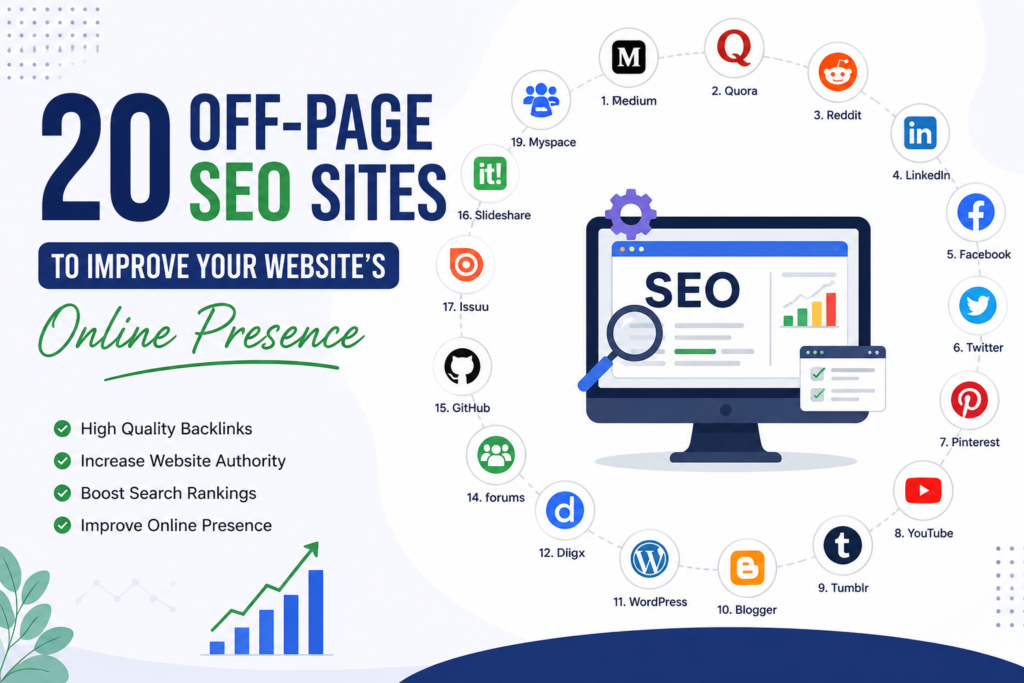
In this blog, we will explore 20 popular off-page SEO platforms and sites that can be used for content promotion, brand visibility, referral traffic, community engagement, and, where appropriate, natural backlink opportunities.
Important: Before using any platform, always check its current guidelines, link policies, and relevance to your niche. Avoid submitting the same content everywhere or creating spammy links just for SEO.
What Is Off-Page SEO?
Off-page SEO refers to optimization activities that happen outside your own website. These activities help search engines and users understand your website’s reputation, relevance, popularity, and authority.
Common off-page SEO activities include:
- Guest posting
- Social media promotion
- Content publishing
- Social bookmarking
- Business listings
- Forum participation
- Question-and-answer platforms
- Image and video sharing
- Document sharing
- Digital PR
- Brand mentions
- Influencer collaborations
- Community engagement
A successful off-page SEO strategy focuses on building a natural online presence rather than simply collecting backlinks.
Why Are Off-Page SEO Sites Important?
Off-page SEO sites can help businesses and website owners in several ways.
1. Improve Brand Visibility
Publishing useful content on popular platforms can introduce your brand to a larger audience.
2. Generate Referral Traffic
People may discover your content on another platform and visit your website.
3. Build Online Authority
Being mentioned, featured, or shared by relevant websites can help strengthen your brand’s online presence.
4. Create Content Distribution Opportunities
A single blog post can be promoted through social media, communities, visual platforms, and other relevant channels.
5. Support Local SEO
Business directories and local listing platforms can help customers discover your business online.
Modern SEO resources generally emphasize using a diverse mix of legitimate platforms rather than relying heavily on bulk directory or submission sites.
20 Off-Page SEO Sites
1. Medium
Website: Medium
Medium is a popular online publishing platform where individuals and businesses can publish articles and share knowledge.
How to use it for off-page SEO:
- Publish useful and original articles.
- Build your personal or business profile.
- Add relevant contextual references to your website when appropriate.
- Share your Medium articles with your audience.
- Focus on providing value instead of keyword stuffing.
Medium is particularly useful for content distribution and reaching readers interested in your industry.
2. LinkedIn
Website: LinkedIn
LinkedIn is a professional networking platform that can be used to build brand awareness and professional credibility.
How to use it:
- Create a professional company page.
- Share industry-related posts.
- Publish useful articles.
- Participate in relevant discussions.
- Add your website to your profile or business information.
LinkedIn can be especially useful for B2B businesses, agencies, consultants, freelancers, and professionals.
3. Reddit
Website: Reddit
Reddit is a community-based platform with thousands of topic-specific communities called subreddits.
How to use it:
- Find subreddits related to your industry.
- Participate in discussions.
- Answer questions honestly.
- Share useful resources only when they are genuinely relevant.
- Follow each community’s rules.
Reddit should not be used for aggressive self-promotion. Community participation is more important than simply posting links.
4. Quora
Website: Quora
Quora is a question-and-answer platform where users ask questions and receive answers from the community.
How to use it:
- Search for questions related to your niche.
- Write detailed and helpful answers.
- Include your website only when it provides additional useful information.
- Build authority by consistently answering relevant questions.
Quora can help businesses reach people who are actively searching for information or solutions.
5. Pinterest
Website: Pinterest
Pinterest is a visual discovery platform that works well for industries such as fashion, travel, food, beauty, home decor, education, and digital marketing.
How to use it:
- Create attractive images.
- Design infographics.
- Create topic-specific boards.
- Write keyword-focused but natural descriptions.
- Link Pins to relevant pages on your website.
Pinterest can be useful for visual discovery and referral traffic.
6. Flipboard
Website: Flipboard
Flipboard is a content discovery and curation platform.
How to use it:
- Share high-quality articles.
- Create collections around specific topics.
- Curate useful industry content.
- Promote educational resources.
It can be a useful additional channel for distributing relevant content.
7. Scoop.it
Website: Scoop.it
Scoop.it is a content curation platform where users can discover and organize content around specific subjects.
How to use it:
- Create topic-based collections.
- Curate useful resources.
- Share your own content where relevant.
- Focus on a specific niche.
The best approach is to combine your own content with genuinely useful third-party resources.
8. Tumblr
Website: Tumblr
Tumblr is a microblogging platform that supports text, images, videos, and other content formats.
How to use it:
- Create a branded profile.
- Publish short articles.
- Share visual content.
- Create niche-related posts.
- Engage with relevant communities.
Tumblr can be useful as an additional content distribution channel.
9. Behance
Website: Behance
Behance is a creative portfolio platform, especially useful for designers, agencies, photographers, and creative professionals.
How to use it:
- Upload design projects.
- Create case studies.
- Showcase branding work.
- Display website designs.
- Add relevant project information.
For creative businesses, Behance can help improve visibility and showcase expertise.
10. Flickr
Website: Flickr
Flickr is an image-sharing platform.
How to use it:
- Upload original images.
- Use descriptive titles.
- Add appropriate tags.
- Write useful image descriptions.
- Organize images into albums.
It can be useful for photographers, travel businesses, designers, and brands with strong visual content.
11. YouTube
Website: YouTube
YouTube is one of the world’s largest video platforms and can be a valuable channel for content promotion.
How to use it:
- Create educational videos.
- Publish tutorials and guides.
- Optimize video titles and descriptions.
- Add relevant website information.
- Encourage viewers to explore additional resources.
Video content can help businesses reach users who prefer visual learning.
12. SlideShare
Website: SlideShare
SlideShare allows users to share presentations and professional documents.
How to use it:
- Convert blog posts into presentations.
- Create educational slides.
- Publish industry reports.
- Share tutorials and case studies.
For example, a blog about digital marketing can be converted into a presentation such as “10 Digital Marketing Strategies for Beginners.”
13. Google Business Profile
Website: Google Business Profile
Google Business Profile is important for businesses that serve customers locally or have a physical location.
How to use it:
- Create or claim your business profile.
- Add accurate business information.
- Include your business website.
- Add business categories.
- Upload photos.
- Keep business hours updated.
- Encourage genuine customer reviews.
Local business listings remain one of the more useful forms of website submission because they can directly help customers discover legitimate businesses.
14. Bing Places
Website: Bing Places for Business
Bing Places allows businesses to manage their presence across Microsoft’s search ecosystem.
How to use it:
- Create or claim your business listing.
- Add correct business information.
- Include your website.
- Add business categories and photos.
- Keep your contact information consistent.
Consistent business information across trusted platforms can support local visibility.
15. Diigo
Website: Diigo
Diigo is a social bookmarking and research platform.
How to use it:
- Save useful industry resources.
- Organize content with tags.
- Bookmark relevant articles.
- Create topic-based collections.
Do not use it only for self-promotional links. A natural mix of useful resources is a better approach.
16. Pearltrees
Website: Pearltrees
Pearltrees is a content organization and discovery platform.
How to use it:
- Create collections around your niche.
- Organize useful resources.
- Include your own content where appropriate.
- Build topic-focused collections.
It can be useful for organizing content and increasing discoverability.
17. BizSugar
Website: BizSugar
BizSugar is focused on business-related content and discussions.
How to use it:
- Share useful business articles.
- Participate in the community.
- Discover industry-related content.
- Promote genuinely helpful resources.
This platform may be particularly relevant for entrepreneurs, marketers, and small businesses.
18. Blogger
Website: Blogger
Blogger is a blogging platform that allows users to create and publish content.
How to use it:
- Create a niche-related blog.
- Publish useful supporting content.
- Build topic clusters.
- Link naturally to relevant pages when appropriate.
Do not create multiple low-quality blogs simply to generate backlinks. One useful, well-maintained property is better than many spammy websites.
19. WordPress.com
Website: WordPress.com
WordPress.com provides users with the ability to create and publish blogs and websites.
How to use it:
- Create valuable niche content.
- Publish unique articles.
- Develop a professional profile.
- Use relevant internal and external references naturally.
Publishing platforms can be useful when the content is genuinely helpful and not created only for link manipulation.
20. GitHub
Website: GitHub
GitHub is mainly used by developers and technology professionals to host and collaborate on projects.
How to use it:
- Publish open-source projects.
- Share documentation.
- Create useful tools.
- Add project-related website information.
- Build credibility within the technology community.
GitHub should only be used when it is genuinely relevant to your business or website. It is not a general-purpose backlink submission platform.
How to Use These Off-Page SEO Sites Effectively
Simply creating accounts on 20 websites will not automatically improve your search rankings. A better strategy is to use each platform according to its purpose.
Step 1: Choose Relevant Platforms
Select websites based on your business and audience.
For example:
- Digital marketing agency: LinkedIn, Medium, Quora, YouTube and Reddit.
- Fashion business: Pinterest, Instagram, Behance and YouTube.
- Local business: Google Business Profile and Bing Places.
- Technology company: GitHub, LinkedIn, Medium and Reddit.
Step 2: Create High-Quality Content
Your content should be:
- Original
- Useful
- Relevant
- Easy to understand
- Visually attractive
- Created for real users
A single valuable article or resource can be more useful than dozens of low-quality submissions.
Step 3: Avoid Duplicate Content
Do not copy and paste the exact same article across every platform.
Instead, repurpose the content.
For example:
Original Blog: Complete Guide to Digital Marketing
You can convert it into:
- A LinkedIn article
- A Medium summary
- A SlideShare presentation
- A YouTube video
- A Pinterest infographic
- Several Quora answers
This allows you to promote the same topic in different formats.
Step 4: Use Natural Anchor Text
Avoid repeating the same keyword in every backlink.
Instead, use a natural combination of:
- Brand name
- Website URL
- Generic phrases
- Topic-related phrases
For example:
- Learn more
- Visit our website
- Digital Marketing Guide
- Your Brand Name
Step 5: Focus on Referral Traffic
Do not judge every platform only by whether a link is dofollow or nofollow.
A link that brings relevant visitors, creates brand awareness, or helps your content get discovered can still be valuable.
Step 6: Engage With Real Users
Participate in:
- Discussions
- Communities
- Comments
- Questions
- Industry conversations
Real engagement can create stronger long-term results than automated link submission.
Recent SEO guidance increasingly emphasizes quality, relevance, audience value, and natural link patterns over mass submissions or automated backlink creation.
Common Mistakes to Avoid in Off-Page SEO
1. Creating Too Many Low-Quality Backlinks
Thousands of irrelevant backlinks are not automatically beneficial.
Focus on relevance and quality.
2. Using Automated Submission Tools
Automated submissions can create repetitive and unnatural link patterns.
3. Keyword Stuffing
Avoid using the same keyword repeatedly in profiles, descriptions, and anchor text.
4. Posting Duplicate Content Everywhere
Create unique versions or repurpose content into different formats.
5. Ignoring Platform Rules
Every platform has its own content and community guidelines.
Always follow them.
6. Using Irrelevant Websites
A backlink or mention from an unrelated platform may provide little value and can look unnatural if your entire strategy follows this pattern.
7. Focusing Only on Dofollow Links
A healthy online presence can include different types of links, mentions, citations, and traffic sources.
Best Off-Page SEO Strategy for Beginners
If you are just starting with off-page SEO, follow this simple process:
Week 1: Build Your Foundation
Create and optimize profiles on:
- Google Business Profile, if applicable
- Bing Places, if applicable
- Pinterest, if relevant
- YouTube, if you create videos
Week 2: Publish Useful Content
Create:
- One detailed blog post
- One LinkedIn post
- One Medium article or summary
- One infographic
- One presentation
Week 3: Community Engagement
Participate in:
- Reddit communities
- Quora questions
- Relevant professional discussions
Week 4: Analyze Results
Track:
- Referral traffic
- Website visits
- Engagement
- Brand searches
- Keyword performance
- Indexed pages
Continue improving the platforms that bring real results.
Conclusion
Off-page SEO is much more than submitting your website to hundreds of directories. A successful strategy focuses on quality content, relevant platforms, genuine engagement, brand visibility, referral traffic, and natural authority building.
The 20 platforms mentioned in this blog—including Medium, LinkedIn, Reddit, Quora, Pinterest, YouTube, Google Business Profile, Bing Places, and other content-sharing communities—can help you distribute content and build an online presence when used correctly.
The most important thing to remember is that quality is more important than quantity. Instead of creating hundreds of low-quality backlinks, focus on publishing useful content, participating in relevant communities, and earning genuine attention from your target audience. Bulk, low-quality submission strategies are increasingly considered ineffective or risky compared with relevant, audience-focused promotion and editorial link earning.
A strong off-page SEO strategy takes time, consistency, and effort, but it can support long-term visibility and help your website reach the right audience.
Frequently Asked Questions (FAQs)
1. What is off-page SEO?
Off-page SEO refers to SEO activities performed outside your website to improve online visibility, authority, brand awareness, and referral traffic.
2. Are backlinks important for off-page SEO?
Yes, relevant and trustworthy backlinks can be valuable. However, quality and relevance are generally more important than simply having a large number of links.
3. Are all off-page SEO sites free?
No. Some platforms are free, while others may offer premium features, advertising options, or paid publishing opportunities.
4. Can I submit my website to all 20 sites in one day?
It is better to focus on quality rather than speed. Create complete profiles and share genuinely useful content instead of rushing through submissions.
5. Which off-page SEO site is best for local businesses?
Google Business Profile and Bing Places are useful starting points for businesses that serve customers in specific locations.
6. Which platforms are best for content promotion?
Medium, LinkedIn, Reddit, Quora, Pinterest, and YouTube can be useful depending on your industry and target audience.
7. Does every backlink need to be dofollow?
No. A link can still provide value through referral traffic, brand awareness, discovery, and audience exposure even if it does not pass traditional link equity.
8. Is social bookmarking still useful for SEO?
Social bookmarking can still be useful for content discovery and referral traffic when used naturally. However, mass bookmarking or spam submissions should be avoided.
9. How many backlinks should I create per month?
There is no universal number. The right amount depends on your industry, competitors, website quality, and the availability of relevant opportunities. Focus on earning useful and relevant links rather than targeting an arbitrary number.
10. How long does off-page SEO take to show results?
Off-page SEO is generally a long-term process. Results can vary depending on your competition, website quality, content, industry, and the quality of your promotional efforts.
11. Can I use the same article on multiple off-page SEO platforms?
It is generally better to create unique versions, summaries, or different content formats instead of copying the exact same article across every platform.
12. What is the best off-page SEO strategy?
The best strategy is a combination of high-quality content promotion, relevant link earning, community participation, local listings where appropriate, digital PR, guest contributions, and building genuine relationships within your industry.